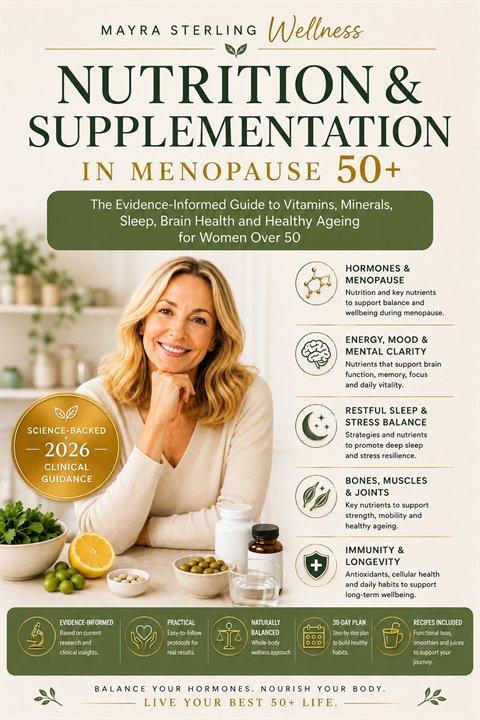
The short version: after fifty your body absorbs, uses and loses nutrients differently — and the standard advice is written for a body that is not doing that. This is a reference book rather than a programme: a clinical profile of each vitamin, mineral and compound that matters at this stage, what the evidence actually supports, which forms are worth paying for, and which combinations work against each other when taken together.
Why supplement after 50 at all
This book starts by arguing against itself, which is unusual and deliberate. Most supplements are unnecessary for most people. What changes after menopause is specific and short: bone turnover accelerates, muscle is harder to keep, absorption of some nutrients declines, and a handful of deficiencies become genuinely common rather than rare.
That is a narrow list, not a cupboard full of bottles. The purpose here is to identify which few apply to you and let you stop buying the rest.
The part that surprises most readers is the section on interactions. Several supplements women commonly take together compete for absorption — taken in the same glass of water, you get less of both than if you had taken one. Timing is not a detail here; it is often the whole difference.
The questions this book answers
If you have ever stood in a pharmacy holding two boxes with no way to choose between them, this book is the answer to that moment.
A reference, not a regime
This one is structured differently from the rest of the series. It is built to be consulted rather than read straight through:
- Clinical profiles — each nutrient gets its own entry: what it does, the form, the timing, the evidence.
- A symptom map — start from what you are experiencing and work back to what might be missing.
- Synergies and antagonisms — which pairs help each other, and which must be separated by hours.
- A master decision table — the whole book compressed into one page you can act from.
Part VII turns all of it into a single thirty-day routine, so the reference becomes something you actually do rather than something you look things up in.
What is inside
Eight parts, plus tools and a bonus
- Foundations — what changes in your body, the symptom map, and which blood tests to ask for
- Synergies and antagonisms — which nutrients help each other and which compete
- The vitamins — clinical profiles: D3, K2, C, E, the B group, B12, biotin and A
- The minerals — calcium, the magnesium forms, zinc, selenium, iron, iodine and the trace group
- Healthy fats and antioxidants — omega-3 with high EPA and DHA
- Advanced menopause supplements — creatine, collagen peptides, isoflavones, melatonin, ashwagandha, probiotics
- 2026 science breakthroughs in plain English — urolithin A, GlyNAC, magnesium L-threonate, the gut–oestrobolome axis
- The practice — master decision table and your 30-day routine
- Common mistakes and safety — including what not to combine
Bonuses: 10 functional teas and juices, plus the interactive tools.
The chapter on common mistakes and safety is the one to read first if you are already taking several things. More is not better with supplements, and a few popular combinations are genuinely worth reviewing.
Stop guessing in the pharmacy
Instant download. Go straight to the master decision table, then read the profiles that apply to you.
Get the PDF edition — $9Who this is for
- Women over 50 already taking supplements who want to know which ones are actually earning their place.
- Anyone who has been told to “take vitamin D” with no dose, no form and no timing.
- Women who want to arrive at a GP appointment knowing which blood tests to request.
- Anyone who would rather spend less on supplements and more of it on the right ones.
Who it is not for: anyone wanting a brand to buy or a personalised prescription. It gives you the evidence and the framework; the decisions and the doses stay between you and your doctor, particularly if you take any medication.
Common questions
What supplements should a woman over 50 take?
A much shorter list than the industry suggests. What genuinely changes after menopause is specific — bone turnover, muscle maintenance, reduced absorption of certain nutrients, and a handful of deficiencies that become common at this stage. The book profiles each candidate with its evidence so you can identify the few that apply to you and stop buying the rest.
Which form of magnesium is best?
They are not interchangeable. Glycinate, L-threonate and dimalate behave differently in the body and suit different purposes, which is why so many women take magnesium and conclude it did nothing. Each form has its own profile in the minerals section.
Can supplements interact with each other?
Yes, and this is the most commonly missed part. Several nutrients women take together compete for absorption — taken in the same glass you absorb less of both. The book has a dedicated section on which pairs work together and which need separating by hours.
Is creatine safe for women over 50?
It is one of the better-evidenced compounds for this age group, for muscle maintenance and, more recently, for cognitive function. It has its own clinical profile in the advanced section, including the 2025 trial data.
Which format should I buy?
The PDF from Gumroad if you want the tables printable and searchable — this is a reference book and most readers want it on a device they can search. Kindle and Google Play Books are the same book in reflowable ebook form.
Sources and further reading
Independent information from public health organisations, if you want to check what this page says or read further:
- NHS — Vitamin D
- NHS — Symptoms of menopause and perimenopause
- The Menopause Society — Menopause topics
About the author
Mayra Sterling writes practical wellness guides for women over 50 — on sleep, stress, brain fog, gut health and the nervous system. The books are built the way she wanted to be spoken to: no scare tactics, no supplement affiliate links, no promises of a cure. Just an honest explanation of what changed in your body and what you can do about it this week. More about Mayra.
 Gut Health Reset for Women Over 50
 Brain Fog Reset for Women Over 50
 Cortisol Reset for Women Over 50
 The Perimenopause Reset Workbook